Universal Conferencing | Conference Server Software
Multi-Mic Conferencing Software: Narrowband, Wideband, and Mixed Narrowband/Wideband capable
Multi-Microphone, VoIP (Packet), and Analog Conference Server Software Engine for conference phone equipment.

The Adaptive Digital Technologies Conferencing software, Conferencing server software is designed to provide conference call capability to telephone systems as well as to voice and video conference servers. Our conferencing algorithm adds the active conference input signals together to form a composite signal. Before sending the composite signal back to each conference party, that party’s transmission is removed from the composite signal to avoid the perception of echo.
- Excellent voice quality maintained even in large conferences
- Supports TDM or packet interface for input and output data
- Number of conference participants is user configurable: Participants can be added and deleted from conference at any time
- Provides voice playback and voice record of conference members and composite signal
Conference Phone System Engine
The implementation of Adaptive Digital’s Conference Engine in your application eliminates echo and enhances voice quality thus creating call clarity, and therefore increasing call productivity
Our product and service offerings draw from extensive industry experience. Because of our extensive knowledge of digital voice processing we are well equipped to provide our customers the resources and support necessary for them to exceed the existing standard in voice quality.
Our engineers work closely with the customer’s engineering staff to transfer technologies, thus ensuring quick integration of licensed components into the customers’ product.
Enterprise
WB / NB Turnkey Solution: The number of conferences and number of members per conference is fully programmable, providing the ultimate flexibility. Both are available in wideband, narrowband, and mixed band versions. HD AEC echo cancellation with noise reduction included.
VoIP Packet
Adaptive Digital’s VoiceAlliance™
Linux based Packet Conference Server
(based on LnxVoice framework) is an all-inclusive core set of voice processing technologies, collaborative tools, and signaling protocols which enables
Packet-to-Packet Audio Conferencing.
SMB
Analog conference engine makes use of our AT&T certified G.168 echo cancellation, HD AEC, tone generation and detection, dynamic noise reduction, and intelligent mic mixing algorithms in order to maximize voice quality, even in very large conferences.
Features List
- Automatic Level Control
- Overflow Protection
- Voice Activity Detection
- Noise Suppression
- Dominant Speaker Selection
- Multi-conference capable
- Functions are “C” callable
- Listen Only Mode
- Audio Switch/Transcoding mode
- Record/Playback of conference input and output audio
- Configurable RTP/Jitter Buffer
- Variable Frame Size
Build that can support different frame sizes among conference members - Preemptive Member Assignment
When a conference member is assigned preemptive status, all other members’ signals will be suppressed and the preemptive member’s signal will be the only signal included the conference sum. - Priority Member Assignment
Normally, conference is configured with a number of dominant speakers, typically three. This means that regardless of how many conference members are present, only the three loudest members will be summed at any given time. By assigning priority status to a conference member, that member’s signal will always be added to the sum.
The conference algorithm is available in a narrowband version (NB), which operates at the typical telephony sampling rate of 8 kHz, as well as a wideband version, which operates at an audio sampling rate of 16 kHz. The wideband version (WB) is suitable to be used in high-end conferencing equipment as well as in VoIP applications in which wideband audio is supported. Also available is the mixed rate version. That is able to bridge together both narrowband and wideband conference (WBNB) parties into a single conference.
Availability
| WB/NB | WB | NB | Platform |
| ✓ | ✓ | ✓ | TI TMS320C64x+ / C66x / C674x |
| ✓ | ✓ | ✓ | TI TMS320C64x |
| ✓ | ✓ | ✓ | TI TMS320C55x |
| ✓ | ✓ | ✓ | TI TMS320C54x |
| ✓ | ✓ | ✓ | ARM Cortex-A |
| ✓ | ✓ | ✓ | ARM9E / ARM11 |
| ✓ | ✓ | ✓ | Linux |
| ✓ | ✓ | ✓ | Win32 (static library accompanying DLL) |
| ✓ | ✓ | ✓ | Win32 (static library) |
| ✓ | ✓ | ✓ | Win32 (DLL) |
ADT Universal Conferencing is available on the above Platforms: Other configurations are available upon request.
Audio Algorithms: Both NarrowBAND and Wideband
- AMR
- G.726
- G.729AB
- G.711A1A2
- MELP
- L16_8K
- L16_16K
- G722 with ADT PLC
- G722.2
- Opus
“Adaptive Digital, a global leader in High Definition acoustic echo cancellation and voice technologies, met our very stringent voice quality requirements. Their acoustic echo cancellation expertise is evident in the extraordinary sound quality that has been achieved in Yealink’s first Conference IP phone.”

Yealink,
Is a global leading unified communication (UC) solution provider that primarily offers video conferencing systems and voice communication solutions.
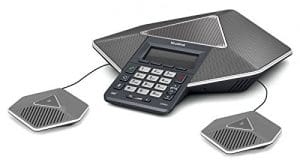
MULTI-MIC SOFTWARE FEATURES: Common to VoIP And Analog Variants
• Supports up to 5 microphones
• Microphone Selection – Intelligent Mic mixing
• Speaker and Microphone Equalization
• Multi-Mic AEC, up to 400 msec echo tail, integrated AGC, Dynamic Noise Reduction, and Howling Control
• Tone Generation
API Functions
API function call summary
Conf_ADT_init (…) Initialize a conference
Conf_ADT_run (…) Perform conferencing function
CONF_ADT_addMember(…) Add a member to a conference
CONF_ADT_removeMember(…) Remove a member from a conference
CONF_ADT_setPriority(…) Set a conference member as a priority speaker
CONF_ADT_clearPriority(…) Clear a conference member’s priority status
CONF_ADT_close(…) Close a conference